
What is a Transformer?
Transformer is an electrical device that transfers energy between circuits and changes alternating-current voltage through electromagnetic induction. A transformer can raise voltage for efficient transmission or lower voltage for safe use in buildings. Transformers may also provide circuit'solation, reduce losses, and support single-phase or three-phase electrical systems.
Quick Facts About Transformer
Category
Electrical power equipment
Used for
Changing AC voltage
Measured by
Voltage ratio and VA or kVA rating
Common confusion
A transformer is not a circuit breaker or voltage regulator.
Also called
Voltage transformer, Power transformer
Often discussed with
Electrical Service Upgrades, Commercial Electrical Repairs
Key Takeaways About Transformer
- Transformers raise or lower alternating-current voltage without changing electrical frequency.
- A transformer does not create power. Higher voltage usually means lower current.
- Nameplate ratings show voltage, phase, frequency, and capacity in volt-amperes or kilovolt-amperes.
- Overheating, buzzing, oil leaks, and damaged insulation can show a serious transformer fault.
Understanding Transformer
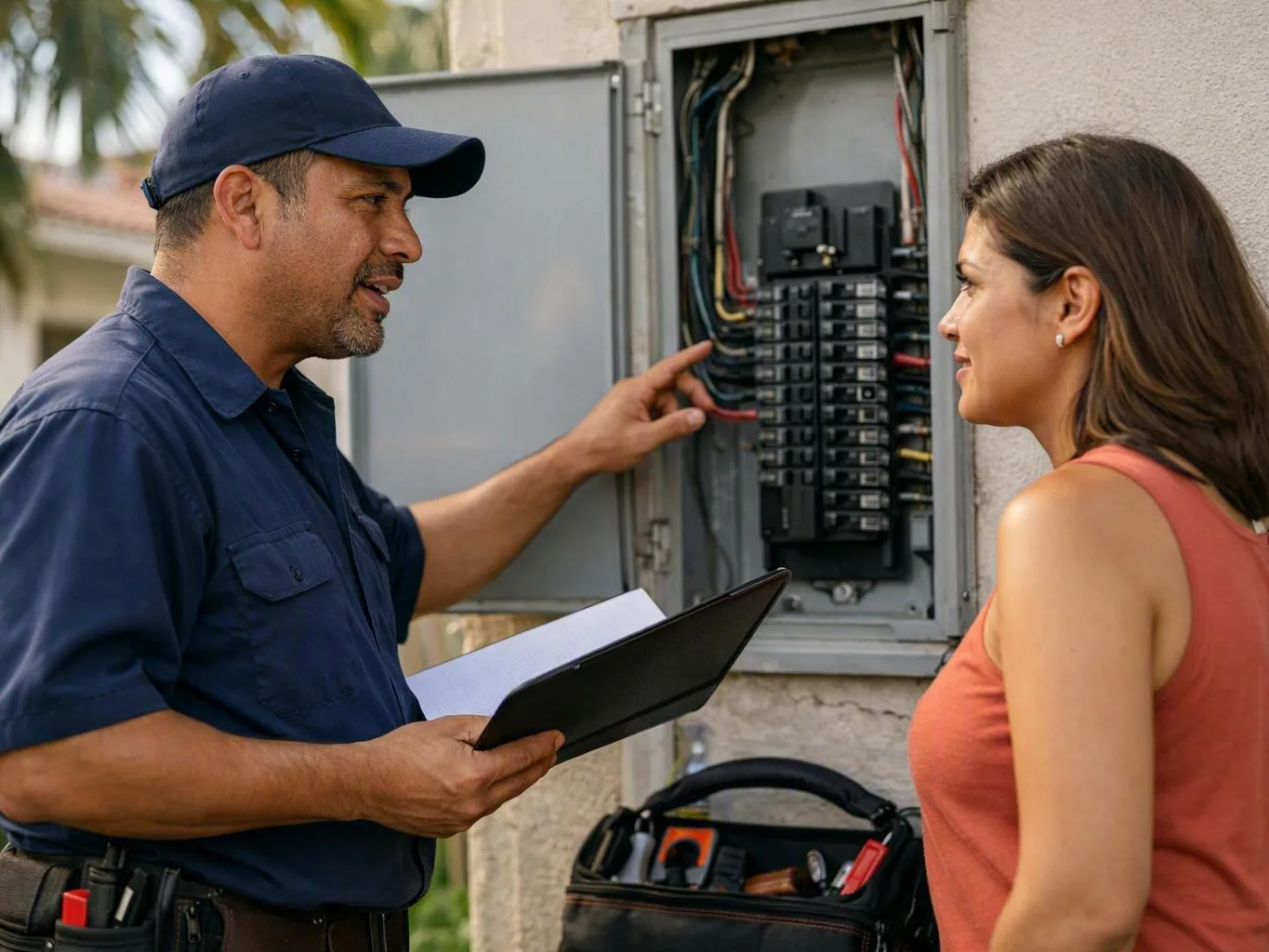
Transformer is a static electrical device. It transfers alternating-current energy from one circuit to another through a magnetic field. Its windings share a magnetic core but normally don't connect directly. This design lets the device change voltage while keeping the supply frequency the same. A transformer may be installed inside a utility system, a building, a panel, or equipment.
Related glossary terms: Three Phase Power, Load Calculation, Overcurrent Protection.
The main parts include primary and secondary windings, a magnetic core, and insulation. The primary winding receives incoming power. The secondary winding sends power at a different voltage. A step-down transformer lowers voltage for building circuits. A step-up transformer raises voltage for transmission or specialized equipment. Some models use air cooling. Larger units may use oil and radiators to control heat.
How Transformer Works, Is Measured, or Is Used?
A transformer works through electromagnetic induction. Alternating current in the primary winding creates a changing magnetic field in the core. That changing field induces voltage in the secondary winding. The voltage relationship mainly depends on the turns ratio. The ratio can be written as V1 divided by V2 equals N1 divided by N2. V represents voltage. N represents winding turns.
Technicians select a transformer by checking the voltage ratio, kVA rating, phase type, frequency, enclosure, and installation location. A 10 kVA unit can support a specific load within its rated conditions. Actual usable capacity depends on connected load, ambient temperature, cooling, and code requirements. Nameplate data also identifies primary and secondary terminals, connection arrangements, impedance, and grounding instructions.
Common applications include utility distribution, control circuits, lighting systems, HVAC equipment, and electronic power supplies. An isolation transformer separates circuits electrically while maintaining a selected voltage ratio. An autotransformer uses part of one winding for both input and output. This can reduce size but doesn't provide the same electrical isolation. Two separate windings provide that isolation.
Why Transformer Matters?

Transformer efficiency affects operating cost, heat, and system capacity. A transformer loses some energy through winding resistance and core magnetization. Poor loading or inadequate ventilation can increase temperature. Excess heat weakens insulation over time and can shorten service life. Correct sizing helps keep voltage within the equipment range and reduces avoidable stress.
Transformer condition also affects electrical safety. Loose connections, damaged insulation, blocked ventilation, moisture, and excessive harmonics can create overheating or fault conditions. A failed unit may interrupt lighting, controls, HVAC equipment, or an entire section of a building. Testing and inspection can identify abnormal temperature, insulation resistance, winding problems, or connection damage. This can happen before a failure spreads.
When Transformer Matters Most?
Transformer selection becomes critical during a service upgrade, equipment installation, generator project, or change in building load. The available supply voltage must match the transformer's primary rating. The secondary voltage must match the connected equipment. Engineers also review short-circuit current, overcurrent protection, working clearance, grounding, and available space.
A transformer needs prompt attention after flooding, fire, lightning, or a major short circuit. It may also need attention after repeated breaker trips. Warning signs include a new humming sound, a hot enclosure, a burning odor, visible arcing, oil leakage, discoloration, and unstable output voltage. Don't open or test energized equipment without the required training, protective equipment, and safe isolation procedures.
How to Evaluate Transformer?
- Verify that primary and secondary voltages match the system and connected equipment.
- Compare the nameplate kVA rating with the calculated continuous and starting load.
- Check phase, frequency, impedance, enclosure type, cooling method, and installation environment.
- Look for overheating, oil leaks, unusual noise, corrosion, damaged insulation, or loose terminations.
- Confirm overcurrent protection, grounding, working clearance, and required electrical permits.
Related Concepts Compared
Transformer vs. Voltage Regulator
A voltage regulator maintains output voltage within a target range as conditions change. A transformer mainly changes voltage through a fixed winding ratio.
Transformer vs. Inverter
An inverter changes direct current into alternating current and may also change voltage. A transformer transfers alternating-current energy but does not convert DC into AC.
Transformer vs. Autotransformer
An autotransformer uses one winding with shared sections for input and output. A conventional two-winding transformer provides electrical separation between the circuits.
Transformer vs. Power Supply
A power supply is a broader system that provides usable electrical power. A transformer may be one internal part of that system.
Expert Note
A transformer can appear sound while carrying damaged insulation or a loose internal connection. Temperature, load history, terminal condition, and test results matter together. A normal voltage reading alone does not prove that the transformer is safe or properly sized.
Common Mistakes or Myths About Transformer
- Installing a transformer with the wrong primary or secondary voltage.
- Selecting capacity from the largest breaker instead of a documented load calculation.
- Blocking ventilation or placing a dry-type transformer in a wet location.
- Assuming a transformer is safe because it still produces the expected voltage.
- Replacing a failed transformer without finding the short circuit or overload that caused the failure.
Transformer in Practice: A Real-World Example
A commercial building gets 480-volt three-phase power, but its lights need 208 volts. A step-down transformer supplies the lower voltage. A technician checks its kVA rating, connections, grounding, and ventilation. The technician checks protective devices before energizing the lighting system.
Sources & Further Reading on Transformer
Related Terms
Three Phase Power
Three Phase Power is an electrical system that delivers alternating current through three conductors, with each…
Load Calculation
Load Calculation is a systematic estimate of the electrical demand a property or circuThat'll place on…
Overcurrent Protection
Overcurrent Protection is a safety system that limits current when electricity exceeds a circuit’s rated capacity…
Electrical Grounding
Electrical Grounding is a planned connection between an electrical system, equipment, or circuit and the earth…
Earth Electric Florida
Have Questions About Transformer?
Contact Earth Electric Florida for practical guidance on Transformer and related emergency electrician work in Miami.